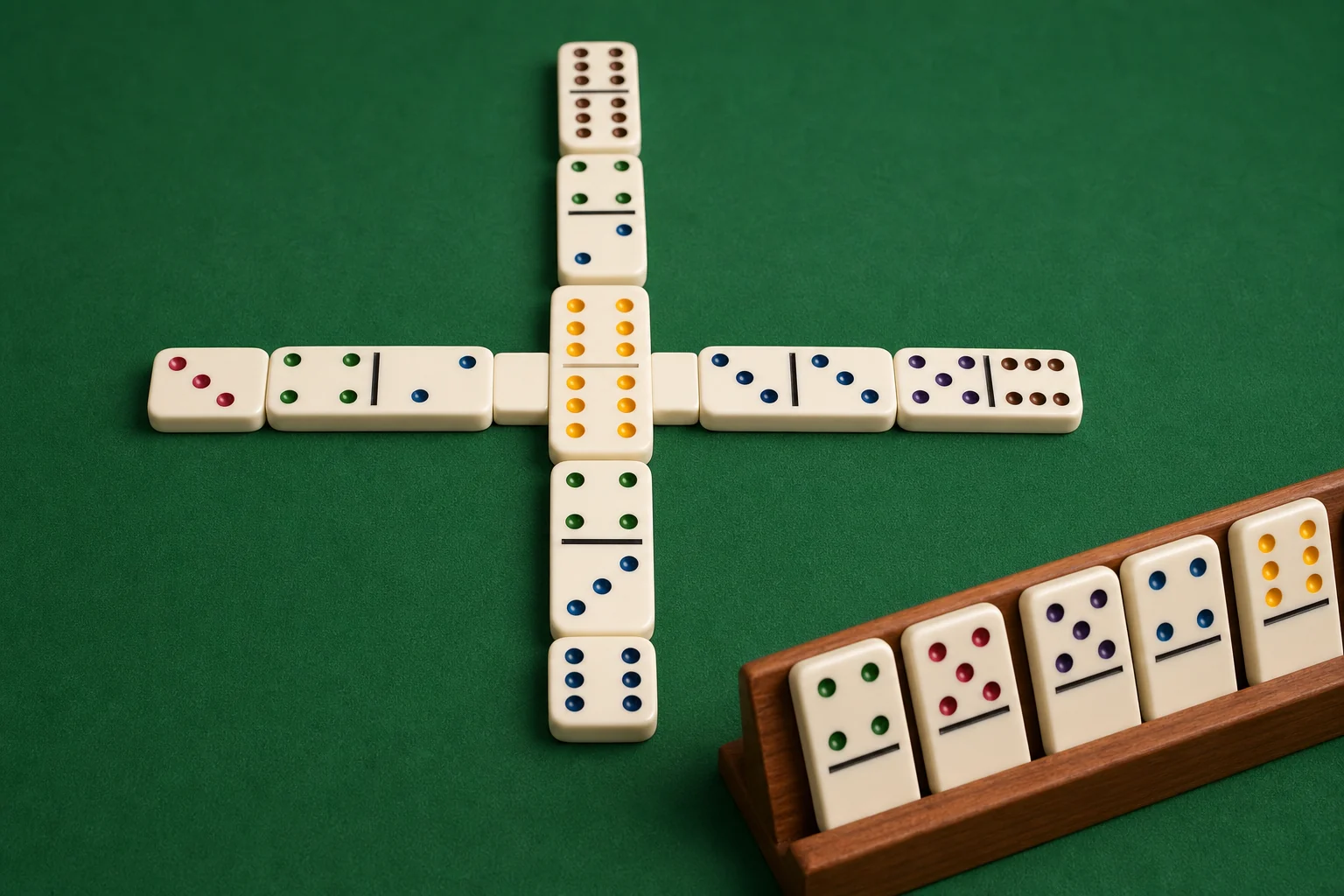
Dominoes is easy to start because the central action is simple: match one half of your tile to an open end on the table. Most casual online games use a double-six set with 28 tiles. Each tile has two halves, each half shows a value from blank to six, and a double has the same value on both sides. Once the first tile is placed, the layout grows as players connect matching values to either end.
The goal changes slightly by rule set, but the basic rhythm stays familiar. Players receive a hand of tiles, take turns in order, and try to empty their hand before the other players do. If you cannot place a tile, the table rules decide whether you draw from the boneyard or pass. Online rooms usually enforce these actions automatically, yet knowing why they happen makes every round easier to read.
The Tile Set and Starting Hand
A standard double-six set contains every possible pair from blank-blank through six-six. Because every value appears on several tiles, a single number can become a useful route through your hand. For example, if you hold several tiles with fives, keeping a five open may give you more future options. If you have only one tile with blanks, you may not want to leave a blank end unless that move solves another problem.
Online dominoes tables normally deal the starting hand instantly. Two-player games often use seven tiles per player, while larger tables may adjust the deal depending on the format. The remaining tiles, if any, become the boneyard. You do not need to memorize every distribution at first. Focus on the values in your hand, the open ends on the board, and the numbers that appear repeatedly during play.
How a Legal Move Works
A legal move must match one of the open ends. If the board has a three on one side and a six on the other, you can play any tile containing a three or a six. The matching half touches the open end, and the other half becomes the new open value. This is why one move can completely change the next player's choices.
Doubles are placed across the line of play in many interfaces, which makes them easy to spot. In basic draw or block dominoes, a double usually behaves like any other matching tile, but it can be harder to play later if the matching number disappears. Some scoring versions treat doubles in special ways, so always check the table description before assuming they are only decorative.
Draw Rules, Block Rules, and Passes
In draw dominoes, a player who cannot move takes tiles from the boneyard until a playable tile appears or the boneyard runs out. This adds uncertainty because drawing can rescue a weak hand, but it also gives the player more tiles to clear. In block dominoes, a player who cannot move simply passes, which makes control of the open ends more important.
A pass is not just a skipped turn. It is information. If a player passes when the board shows twos and fives, you know that player probably lacks both values at that moment. Later in the round, reopening one of those values may pressure the same player again. This kind of observation is one of the first steps from casual matching to strategic play.
How Rounds End
A round usually ends in one of two ways. The cleanest ending happens when a player plays the final tile from their hand. That player has gone out, and the remaining pips in the opponents' hands may determine the score. The other ending is a block, where no player can legally move. In that case, the winner is often the player with the lowest pip total left, although exact scoring can vary.
Because rounds can end suddenly, high-value tiles deserve attention. Holding the six-six near the end of a round is risky if you have no clear way to play it. Beginners often save heavy tiles because they feel powerful, but in many scoring systems those pips become a penalty when another player goes out.
Basic Scoring to Understand
Some dominoes games score only after a round ends. The winner receives points based on the pips left in the other players' hands, or the lowest hand wins a blocked round. Other versions, such as all-fives styles, can also award points during the round when the open ends total a multiple of five. This difference changes how aggressive you should be.
If you are new, start with the simpler goal of going out while keeping your pip count low. Once that feels natural, pay more attention to board totals, doubles, and possible blocks. Good online players are not guessing every turn. They are narrowing the board to numbers that help their hand and reduce the table's options.
A Simple Learning Routine
Before every move, ask three short questions: which numbers are open, which tile keeps my hand flexible, and which tile would be painful to keep if the round ended soon? This small routine slows down rushed decisions without making the game complicated. With practice, it becomes automatic.
Rules are easiest to learn by playing slowly and noticing why each turn works. Read the open ends, watch passes, and use early games to build board awareness. When you are ready to practice these basics in a clean setting, return to the homepage to play dominoes online and apply the rules one move at a time.